Pressure Logger
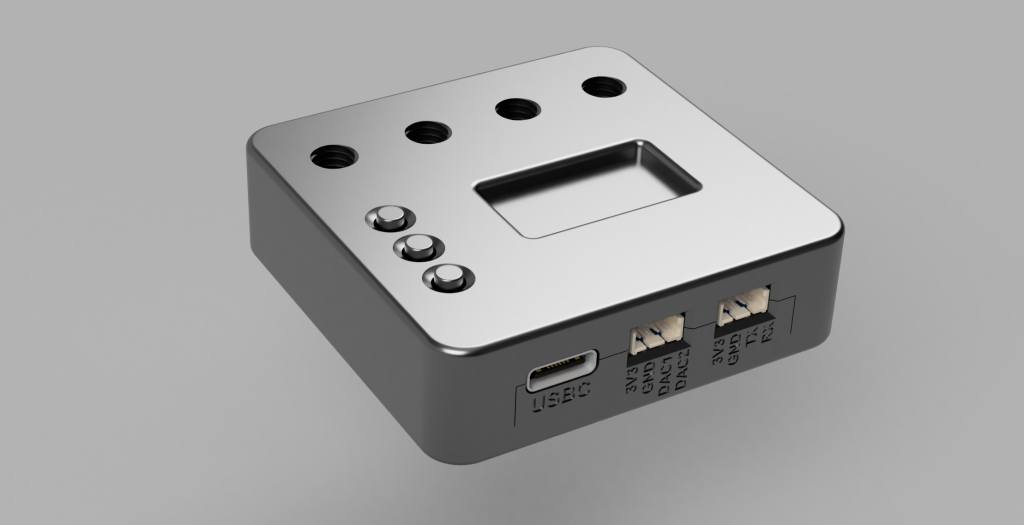
4-Channel High-Resolution Pressure Measurement System
Low noise • Cross-channel calibration • USB/UART logging • Dual analog outputs
Date: March 2026
Overview
Pressure Logger is a compact 4-channel pressure measurement and logging device designed for laboratory, R&D and engineering applications. It measures absolute pressure using digital sensors and outputs data as a continuous serial stream via USB or UART.
Key capabilities
- Up to 4 independent pressure channels
- Two selectable pressure ranges: 260–1260 hPa and 260–4060 hPa
- Sampling presets: 25 / 75 / 100 / 200 Hz (noise vs. speed trade-off)
- Cross-channel calibration (CROSS CAL) stored in non-volatile memory
- ZERO mode for leak testing and small pressure deltas (temporary, cleared on power-off)
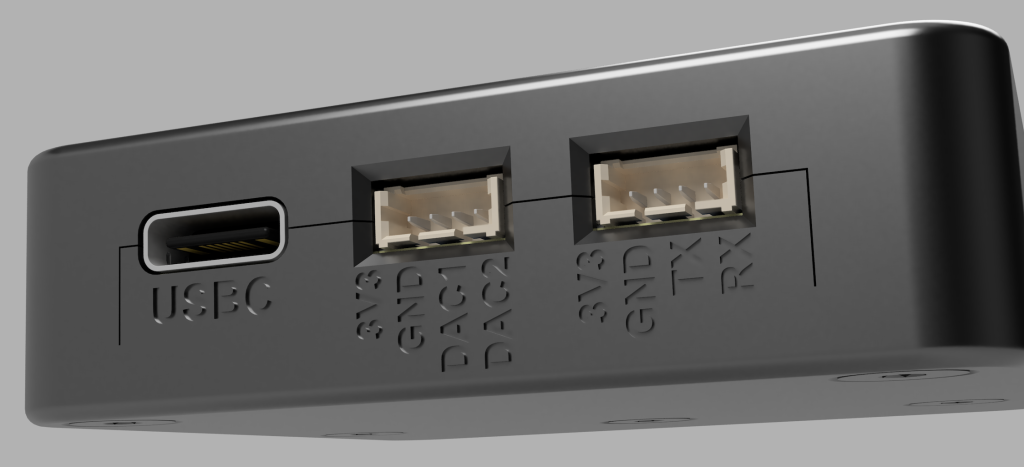
- USB-C (CDC Virtual COM Port) and UART 115200 (3.3 V)
- Two analog outputs (DAC) for CH1 and CH2 (0–3.3 V)
Typical users
- Robotics / pneumatics developers
- Labs doing leak testing and pressure stability experiments
- Fluid systems prototyping and instrumentation work
Sampling presets and typical RMS noise
Noise depends on sampling rate and selected pressure range. Values below are typical RMS noise at stable pressure under normal conditions.
1 hPa = 100 Pa
| Sampling rate | Mode intent | RMS noise 260–1260 hPa | RMS noise 260–4060 hPa |
| 25 Hz | Maximum stability | 0.32 Pa (0.0032 hPa) | 0.57 Pa (0.0057 hPa) |
| 75 Hz | Stable | 0.63 Pa (0.0063 hPa) | 1.43 Pa (0.0143 hPa) |
| 100 Hz | General purpose | 0.83 Pa (0.0083 hPa) | 1.95 Pa (0.0195 hPa) |
| 200 Hz | Dynamic systems | 1.50 Pa (0.0150 hPa) | 3.78 Pa (0.0378 hPa) |
Practical notes
- Higher sampling rate increases noise but improves dynamic response.
- The 260–1260 hPa range provides lower noise than the extended range.
- The device is sensitive enough to detect pressure changes caused by slight heating of an enclosed air volume (e.g., warming a tube by hand).

Interfaces & data
Digital interfaces
- USB: CDC Virtual COM Port (data streaming starts automatically)
- UART: 115200 baud, 8N1, 3.3 V logic
Data format (ASCII stream)
- Units: hPa
- Resolution: 3 decimal places
- Output includes only the active logging channels (1–4)
Examples:
P1:1013.257
P1:1013.257 P2:1013.249
P1:1013.257 P2:1013.249 P3:1013.261
P1:1013.257 P2:1013.249 P3:1013.261 P4:1013.255
Analog outputs (DAC)
- 2 channels: CH1 and CH2
- 0–3.3 V full-scale, linear mapping to selected range
- Range 260–1260 hPa → 0–3.3 V corresponds to 0–1260 hPa
- Range 260–4060 hPa → 0–3.3 V corresponds to 0–4060 hPa
- ZERO mode affects digital readings (display/log) and does not affect DAC output.
Typical applications
Leak testing (sealed systems)
- Use 25 Hz for best stability
- Apply pressure, wait to stabilise, then enable ZERO
- Track pressure drift over time
Hydrostatic level / water column
- Suitable for measuring small pressure changes corresponding to liquid level variation
Pneumatic dynamics
- Fast logging for actuators and pneumatic muscles (e.g., motion capture / running experiments)
- Use 200 Hz to capture transient pressure behaviour
Fermentation / gas generation monitoring
- Long-term monitoring of pressure increase in closed containers (with proper safety precautions)
Mechanical interaction detection
- Detect tube compression / soft actuator interaction through pressure impulse signatures
Technical summary & ordering
Technical summary
- MCU: STM32G431
- Sensors: LPS28 (digital absolute pressure)
- Channels: up to 4
- Pressure ranges: 260–1260 hPa / 260–4060 hPa
- Sampling presets: 25 / 75 / 100 / 200 Hz
- Interfaces: USB CDC, UART 115200 (3.3 V)
- Analog outputs: 2 × DAC, 0–3.3 V
- Power: USB 5 V (default) or external 3.3 V (no protection on headers)
- Current consumption: up to 50 mA
- Maximum pressure: 1 MPa (~10 bar)
Notes
- Not intended for medical or life-support applications.
- Keep electronics dry: the board is not conformally coated.
Contact

Ordering: Tindie